
Quantum Fluid Dynamics: Visualizing Quantum Computing in Hilbert Space
Exploring the Flow of Quantum States, the Power of Interference, and the Fragile Dance of Coherence in the Vast Landscape of Possibility

Quantum mechanics has a way of reshaping our understanding of reality. It challenges our notions of randomness, order, and existence itself, offering an elegant yet perplexing framework for the universe at its most fundamental level. What fascinates me most is how it reveals a deeply relational nature at the heart of everything—where particles, probabilities, and possibilities are interconnected in ways that defy classical logic.
As a coder and long-time enthusiast of quantum mechanics, I've found quantum computing to be a captivating bridge between this abstract realm and practical applications. Recently, I've been diving into Qiskit, IBM's quantum programming framework, experimenting with simulations and manipulating real quantum systems through their transmon architecture. This hands-on exploration has deepened my understanding and sparked a desire to share these concepts in a way that's both accessible and insightful.
Join me on a journey to visualize the fluid and fascinating world of quantum computing—where abstract mathematics meets imagination and discovery. Together, we'll explore how quantum systems evolve with purpose and precision, revealing the beauty hidden in the fabric of reality.
Visualizing the fluid dynamics of quantum states in Hilbert space, where probabilities flow and entanglement weaves connections
Bridging the Quantum Divide Through Imagination
Quantum mechanics is inherently abstract and counterintuitive. Even after years of studying it, I've found that the best way to grasp its complexities isn't solely through equations but through visualization and analogy. Quantum phenomena come alive when imagined as dynamic, tangible processes—waves rippling through space, threads weaving connections, or landscapes rich with hidden potential.
One aspect that stands out is the deeply relational nature of quantum mechanics. It reveals a universe where nothing exists in isolation; particles and probabilities are woven into a web of interactions that transcend space and time. Hilbert space, for example, feels less daunting when I envision it as an infinite chessboard where every possible move exists simultaneously, each shaped by its relationship to the others. Entanglement becomes more vivid when I imagine threads of light linking particles across vast distances. Interference—the amplification or cancellation of probabilities—reminds us that outcomes depend not just on isolated possibilities but on their relationships.
These analogies aren't just creative exercises; they're bridges that transform abstract theory into something intuitively graspable, something beautiful. By exploring the relational nature of quantum systems through these mental images, I connect with a deeper understanding of how the universe works—not as a set of isolated rules but as a network of interactions, all part of a greater whole.
I hope to share that perspective with you—inviting you to see quantum mechanics not as a collection of daunting equations but as a window into the deeper patterns of reality itself. My goal is to make this world less intimidating, more relatable, and alive with wonder.
The Fluid Dynamics of Quantum Computing
As theoretical physicist Sean Carroll humorously noted:
"You can go an entire lifetime without truly understanding what Hilbert space is or how it works, yet it remains indispensable for probing quantum systems."
Hilbert space is a vast, multidimensional landscape—a stage where the drama of quantum mechanics unfolds. It's not a typical three-dimensional playground; it's an infinite chessboard of possibilities, with every conceivable move or combination existing somewhere on its endless grid.
Here, the quantum state—or wave function—acts like a fluid, dynamically evolving and exploring the probabilistic landscape of potential outcomes. However, as quantum computing expert Scott Aaronson emphasizes, it's not that the wave function literally "tries every possibility at once." Instead, quantum mechanics introduces phenomena that are both fascinating and deeply unintuitive:
Superposition allows a particle to exist in multiple states simultaneously—like a ripple on a pond spreading in every direction at once.
Entanglement links particles so intimately that the state of one becomes correlated with the state of another, even across vast distances.
Interference acts as a sculptor: constructive interference amplifies paths leading to correct solutions, while destructive interference cancels out others.
This is where quantum computing diverges significantly from classical computing. Classical systems, confined to binary states and sequential logic, explore solutions one step at a time. Quantum systems, by contrast, leverage the inherent relationality of reality. Within Hilbert space, the wave function doesn't merely compute; it encodes an entire web of possibilities, intertwining dimensions, probabilities, and correlations that classical systems can't effectively model.
Governed by the elegant laws of quantum mechanics, every ripple and twist of the wave plays a role in computation, weaving an intricate tapestry of possibilities. These elements aren't just theoretical; they form the foundation upon which quantum computers solve problems that are far too complex for classical systems, revealing order within seeming randomness.
An abstract visualization of Hilbert space, where flowing quantum waves traverse an infinite chessboard of possibilities.
Quantum Gates: Transformative Currents in the Quantum Flow
At its core, a quantum gate is the quantum equivalent of a classical logic gate. Just as classical gates manipulate bits (0s and 1s), quantum gates manipulate qubits—the fundamental units of quantum information. What sets quantum gates apart is their ability to operate on qubits in superposition, where states like 0 and 1 coexist, and to perform transformations that are inherently reversible.
Quantum gates act as transformative forces that manipulate the flow of the wave function. Each gate applies a precise transformation, shaping the wave's path, altering its direction, and adjusting its momentum within Hilbert space. Think of quantum gates as turbines in a flowing stream, guiding the water without wasting a drop. They preserve coherence while steering probabilities toward regions associated with correct solutions.
For instance:
The Hadamard gate acts like a wave splitter, sending the qubit into an equal superposition of 0 and 1, setting the stage for quantum parallelism.
The CNOT gate (controlled-NOT gate) introduces interaction between qubits. It's like a fork in the stream, where the state of one qubit controls whether the other flips its state, creating the entanglement that powers quantum computing.
As the wave flows, its transformations can be mapped onto the Bloch sphere—a geometric compass that charts the qubit's state as it evolves. The sphere becomes a map of the wave's journey, showing how quantum gates nudge and steer it toward the desired outcome. Together, these gates work in harmony, weaving probabilities toward solutions with elegance and precision.

Quantum gates steer the wave function’s flow, shaping the currents of probability toward an encoded outcome in a sea of potential
The Bloch Sphere: A Quantum Compass
Discovering the Bloch sphere was transformative for me. Superposition—this abstract idea of a particle being in multiple states at once—suddenly felt tangible. Visualizing it as an arrow on a sphere, smoothly rotating to represent the continuous flow of probabilities, made the concept click. It's not a literal depiction of reality, but it's a powerful tool for bridging abstraction and intuition.
To grasp the relational nature of quantum systems, think of the Bloch sphere as a compass navigating a multidimensional landscape. Each point represents a unique quantum state, and the state vector spins and shifts across its surface as the system evolves. Quantum gates act as navigational tools, steering the state vector toward the desired direction.
For multi-qubit systems, the picture becomes even more fascinating. Imagine an intricate web of interconnected compasses, where entanglement binds the movement of one vector to another. Together, they create a synchronized dance through the vast expanse of Hilbert space, revealing the profound interplay between relational quantum states.
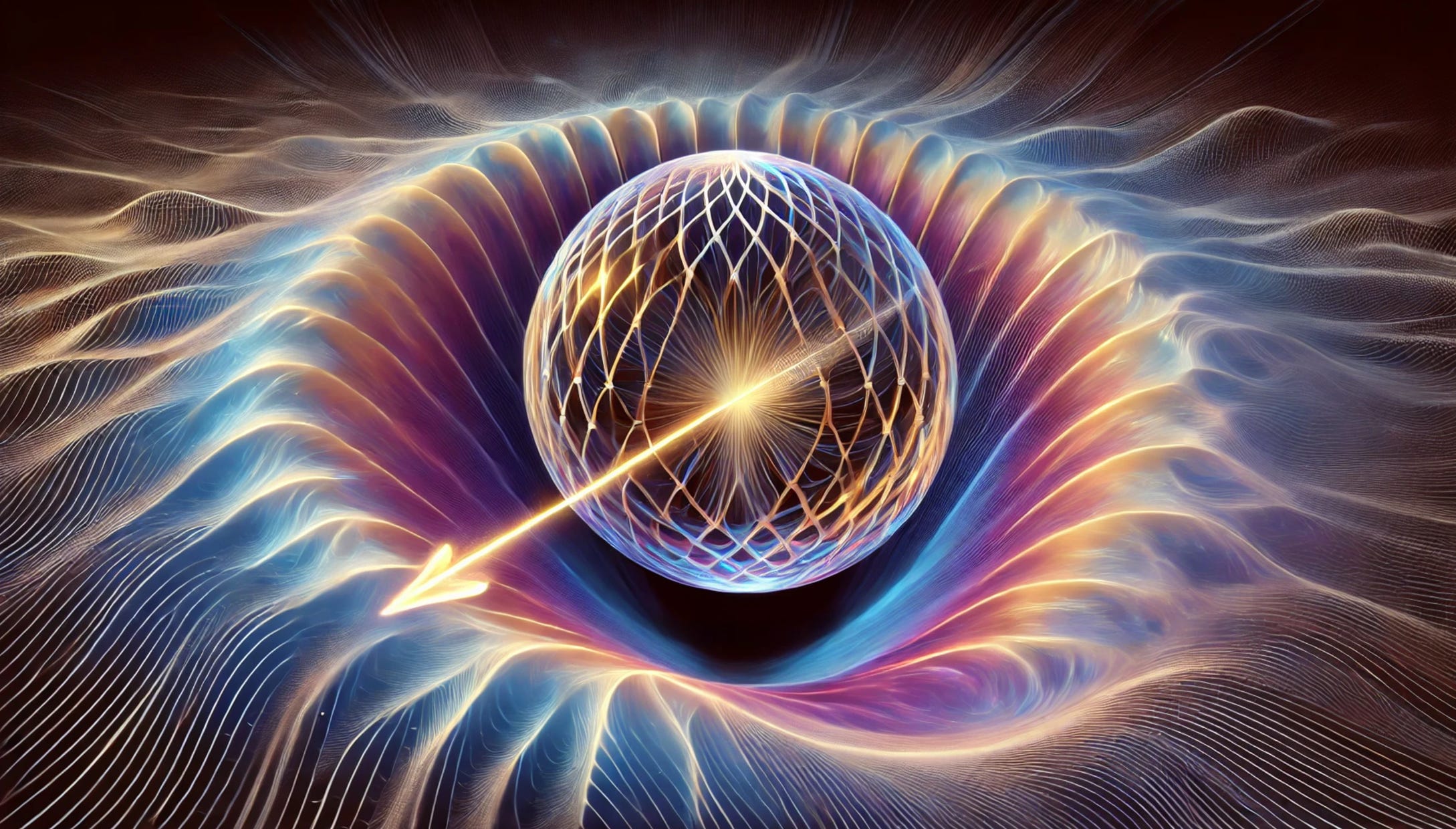
An abstract depiction of the Bloch sphere, illustrating quantum spin dynamics as it hovers above a sea of potential in Hilbert space.
Constructive Interference: Guiding the Quantum Journey
As the quantum state evolves, quantum gates create patterns of constructive and destructive interference within the wave function—a dynamic interplay that shapes its path through Hilbert space. Imagine multiple ripples on a pond colliding; some combine to form larger waves, while others cancel each other out. This is interference in action:
Constructive interference amplifies the probabilities of correct solutions, increasing the amplitude in favorable directions.
Destructive interference suppresses the probabilities of incorrect paths, dampening unwanted ripples.
This delicate choreography of probabilities, guided by quantum gates, lies at the heart of quantum algorithms. Through the interplay of phase, amplitude, and probability, interference sculpts the wave function’s path, amplifying correct solutions and suppressing incorrect ones. By weaving order from a sea of possibilities, quantum algorithms reveal the elegance of computation within the multidimensional landscape of Hilbert space. It’s a process that feels almost intuitive, as if the wave function is uncovering the most elegant path forward—step by step, solution by solution.
An abstract portrayal of quantum interference, where fluid waves of probability merge and cancel, guiding the path to constructive outcomes.
Navigating Hilbert Space: The Schrödinger Equation and Hamiltonian Landscape
At the heart of quantum mechanics lies the Schrödinger equation—a fundamental rule dictating how the wave function evolves over time. Think of it as the "rules of the road," ensuring the wave function flows smoothly through Hilbert space, guided by quantum laws.
The Hamiltonian serves as the system's energy map. It's a mathematical operator defining the landscape through which the quantum state flows, encoding interactions and constraints. Picture it as a multidimensional terrain with peaks and valleys shaping the wave's pathways. The Hamiltonian sculpts this landscape, indicating areas where the wave gathers (low energy) or disperses (high energy).
By navigating this terrain, quantum systems translate the abstract mathematics of Hilbert space into purposeful computation, revealing solutions through the wave function's dynamic evolution. The goal is to steer the wave function so that, upon measurement, it collapses with high probability into the correct solution.
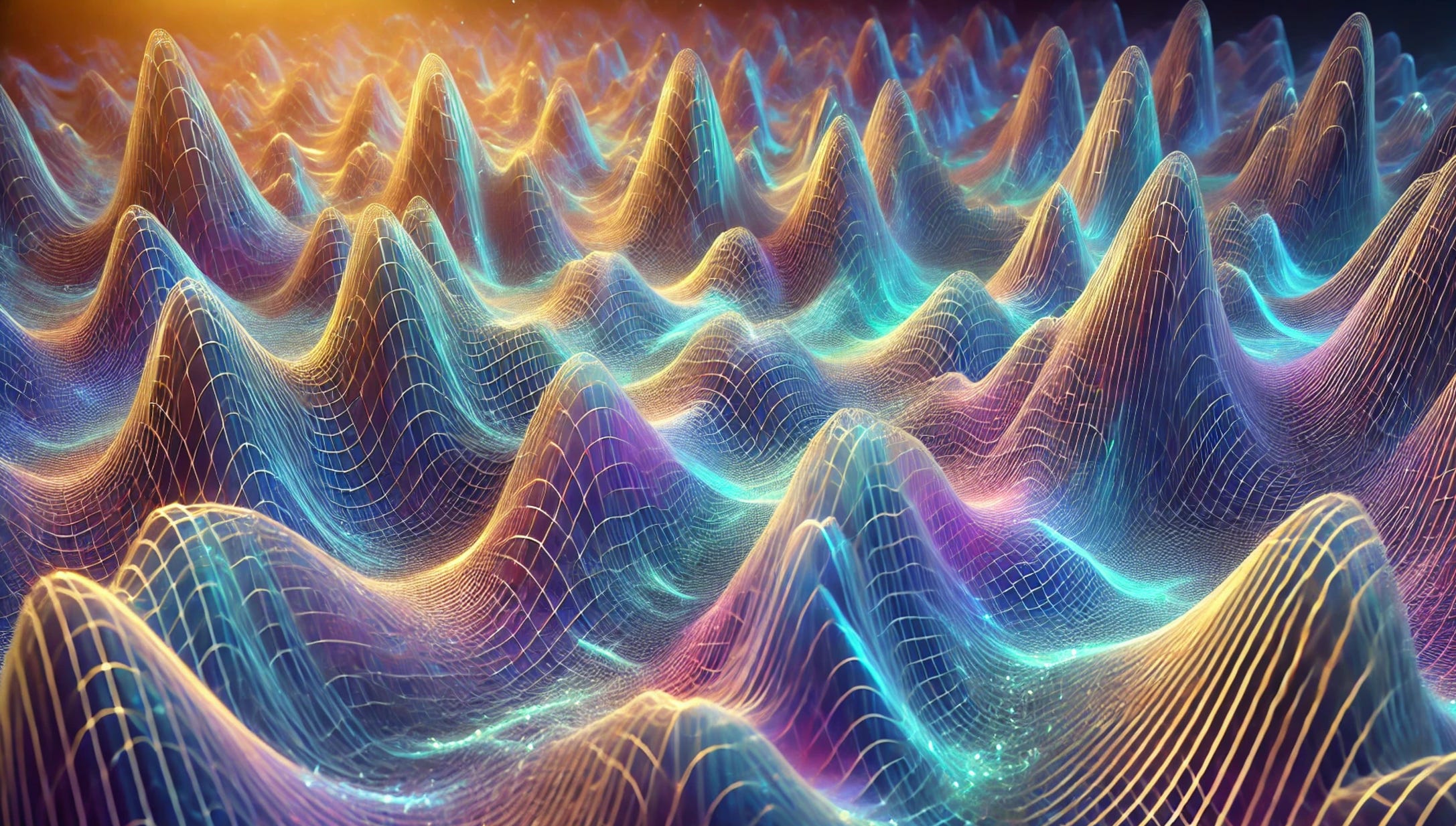
A fluid, multidimensional landscape representing the Hamiltonian's peaks and valleys, where quantum states flow and evolve through high and low energy terrains.
Decoherence: The Turbulence of the Quantum Fluid
Decoherence is one of the biggest challenges in quantum computing—a fragile dance where even the smallest interaction with the environment, like stray electromagnetic fields or thermal noise, can disrupt the delicate balance. Imagine raindrops scattering ripples on a calm pond, breaking the quantum wave's harmony and forcing it to collapse prematurely into a classical state.
Preserving coherence is crucial. Engineers must create environments so isolated and precise that superpositions can be maintained long enough to solve complex problems. Quantum error correction acts as a stabilizing force, countering turbulence and ensuring the wave remains intact, bringing us closer to realizing the immense potential of quantum systems.
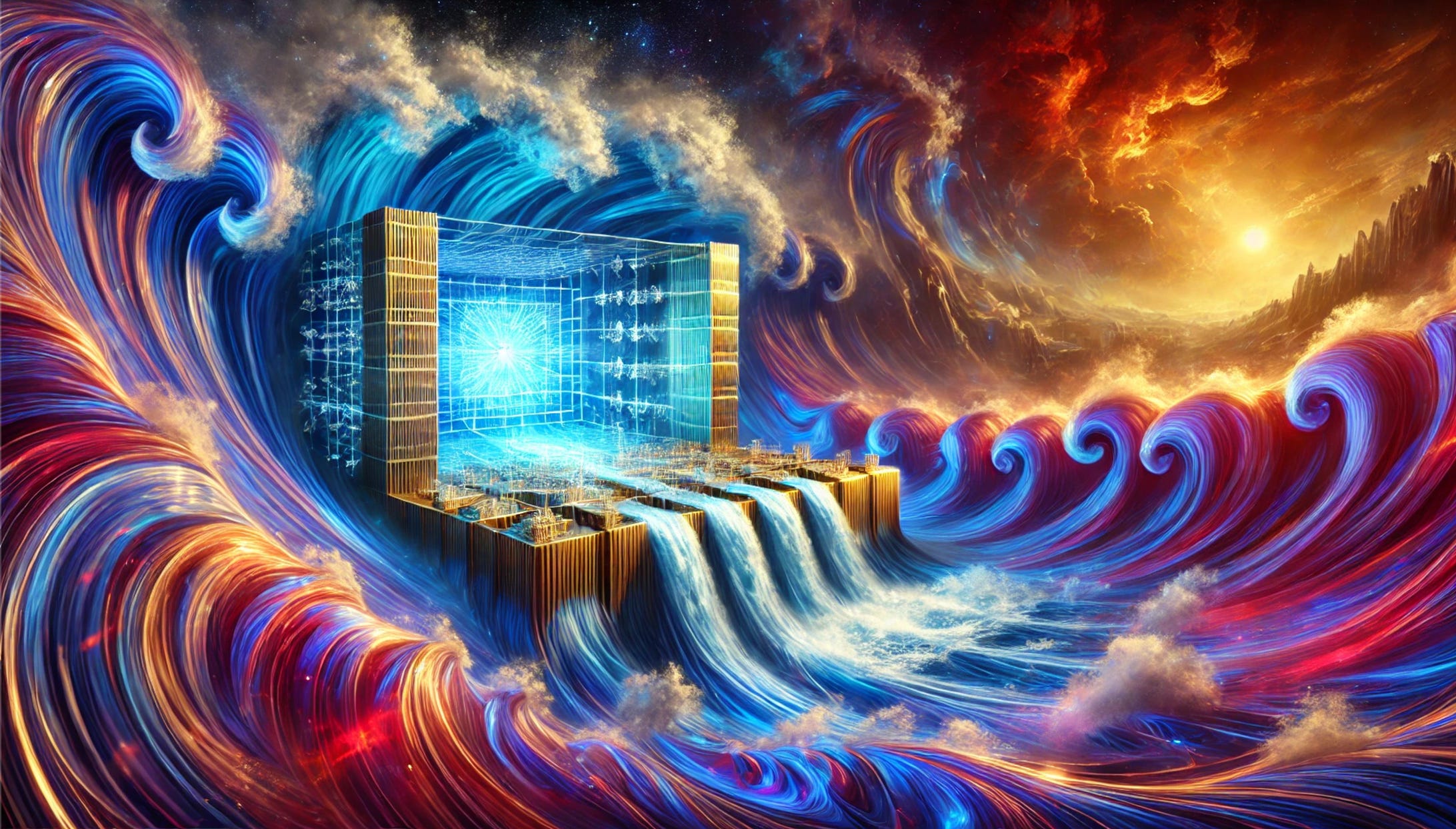
A glowing dam-like structure stabilizes chaotic waves, symbolizing quantum error correction maintaining coherence in a turbulent system.
Entanglement: Threads in the Quantum Web
From the fragility of decoherence, we arrive at one of quantum mechanics' most astonishing features: entanglement. If decoherence reminds us how delicate quantum systems can be, entanglement shows us how profoundly connected they truly are.
Imagine particles that, no matter how far apart, remain mysteriously linked—as though pulling on a thread here correlates with a thread there, across any distance. Entanglement challenges our classical notions of separateness and demonstrates the ultimate quantum relationships.
Entanglement isn't just a curiosity; it's the fabric weaving quantum systems together. It allows qubits to collaborate in ways classical bits cannot, forming a vast, multidimensional web of probabilities. In this web, every thread is both independent and interdependent, creating a dynamic interplay essential for quantum computation.
This interconnectedness, while difficult to fully grasp, is thrilling. It's as if the universe itself shows us that nothing exists in isolation—not particles, not computations, not even ideas. Entanglement reminds us of the beauty of collaboration, both in the quantum realm and beyond.
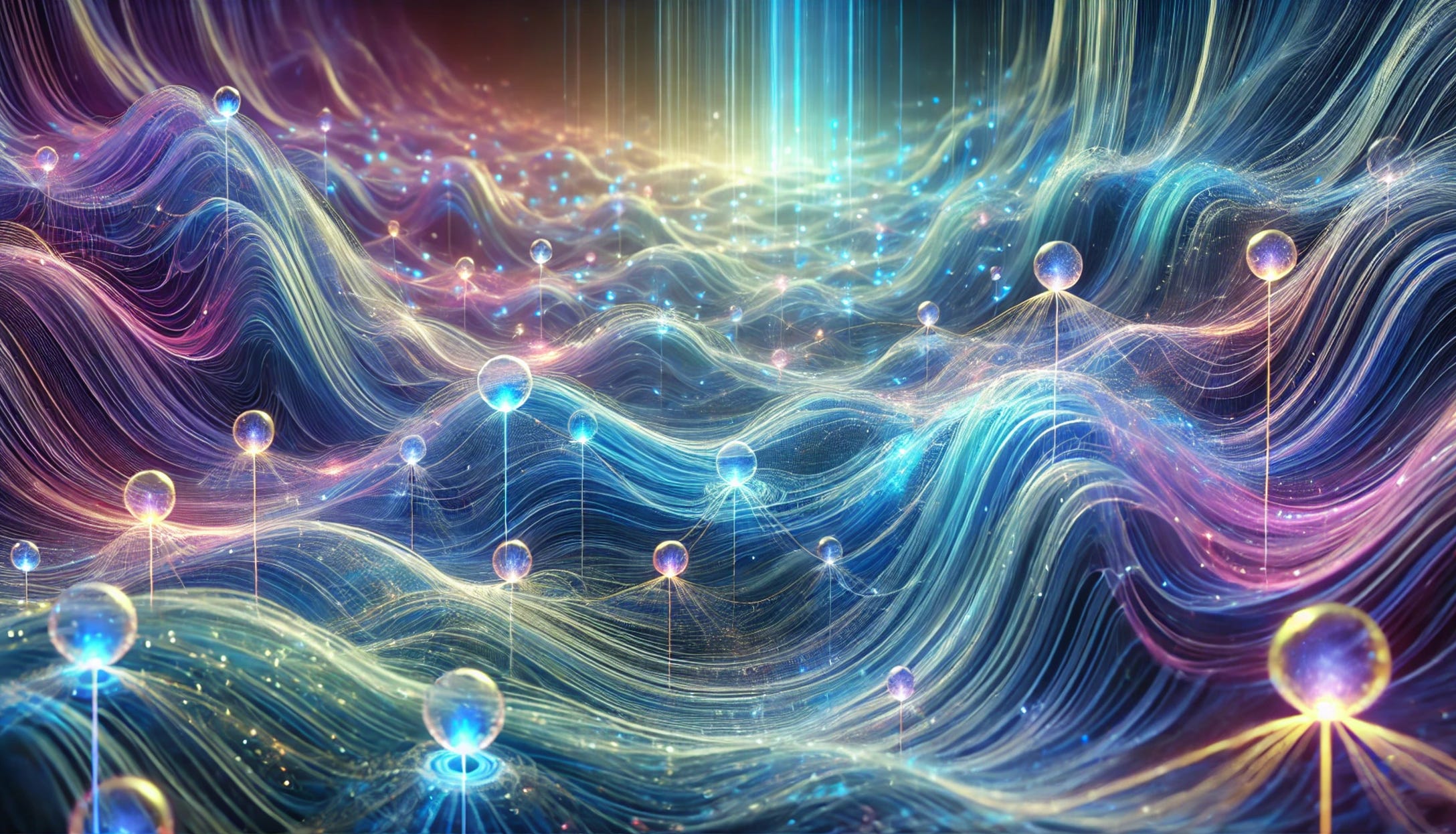
An abstract, wave-like depiction of quantum entanglement, with luminous orbs connected by flowing threads of light across a fluid, oceanic landscape.
Measurement: Crystallizing Possibility into Reality
Measurement marks the final stage of the quantum journey—the moment where possibilities collapse into a singular reality. It's a dramatic transformation: the fluid wave of probabilities, having danced through Hilbert space, settles into a definitive outcome. I think of it as water freezing into ice—what was once dynamic and full of potential becomes solid and tangible.
This crystallization is where the quantum meets the classical. The probabilities, shaped by interference, entanglement, and coherence, converge into one "pool," locking into the solution with the highest likelihood. It's as if the quantum wave has been sculpted by its journey, arriving at measurement with purpose and elegance.
This moment captures the duality of quantum mechanics. It is at once governed by probability and deeply mysterious, hinting at the ordered beauty underlying apparent randomness. Measurement isn't just the end of the process; it's the bridge between possibility and certainty, the culmination of a quantum journey mirroring nature's patterns and precision.
Illustrating the dramatic collapse of quantum possibilities into a single definitive outcome during measurement.
Practical Applications: Quantum Computing in Action
While much of this discussion focuses on the conceptual beauty of quantum computing, it's important to highlight real-world applications that make these concepts tangible:
Cryptography: Quantum algorithms like Shor's algorithm can factor large numbers efficiently, potentially breaking current encryption methods. Conversely, quantum cryptography offers new ways to secure information through quantum key distribution.
Material Science and Chemistry: Quantum simulations can model complex molecular interactions, leading to breakthroughs in drug discovery and the development of new materials.
Optimization Problems: Quantum computers can tackle complex optimization tasks in logistics, finance, and machine learning, finding solutions infeasible for classical computers.
Artificial Intelligence: Quantum machine learning algorithms could process vast datasets more efficiently, accelerating model training and pattern discovery.
These applications demonstrate the power of understanding and harnessing quantum mechanics' fluid dynamics. By translating the abstract into the actionable, quantum computing stands to transform industries and solve problems once thought unsolvable.
A Dynamic and Purposeful Flow
The journey of quantum computing is a dynamic evolution—a dance through Hilbert space where every ripple, twist, and interference shapes the path to discovery. From the fluid probabilities of the wave function to the guiding force of quantum gates, each element contributes to a profound choreography mirroring the universe's complexity.
But this isn't just an abstract spectacle. At the heart of this process lies the remarkable promise of tackling challenges once insurmountable. Quantum computers can map vast landscapes of possibility, optimize supply chains, accelerate drug development, and revolutionize secure communication. These applications remind us that even the most abstract principles of quantum mechanics can transform the world in tangible, meaningful ways.
This interplay between abstraction and reality makes quantum computing so exciting. It's not just about solving problems—it's about redefining how we think, compute, and interact with the very fabric of reality. By harnessing quantum mechanics' intricate structures, we're exploring what's possible and pushing the boundaries of imagination.
As waves crystallize into solutions, we're reminded that every quantum journey is both a technical feat and a reflection of our curiosity—a glimpse into the universe's elegance and interconnectedness. Perhaps, in the process, we're learning not just about quantum mechanics but about ourselves and the infinite potential of human ingenuity.